Devices hacked women and girls blackmailed as cyber abuse grows
Young women and girls are being stalked and abused online, have had their devices and accounts hacked and have been coerced into sending nude or sexual content, in behaviour that has become more pronounced during COVID-19 lockdowns.
The broadest survey yet of front-line support workers, released on Wednesday by leading researchers at Monash University for the National Research Organisation for Women’s Safety, has reported the perpetrators are mostly men aged up to 34, using technology as a means to control and intimidate former and current partners.
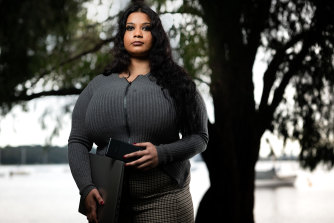
Noelle Martin has experienced tech abuse and is now calling for tougher action against perpetrators.Credit:Tony McDonough
Image-based abuse is identified as a key problem. More than one-quarter of the 338 agencies surveyed were aware of victims who had been threatened with the posting online or sending to others of nude or sexual photos or videos, while one in five has worked with victims who were pressured, coerced or blackmailed into sending explicit images.
Former WA Young Australian of the Year Noelle Martin’s image was stolen and then manipulated to appear in fake pornographic images and videos online. One video used a photo of her from when she was just 17 years old. Ms Martin, now aged 26 and a lawyer, said issuing takedown orders to websites, which the country’s eSafety Commissioner has the power to do, was not enough.
“An image can be taken down one time, at one location, at one site, but it doesn’t mean they’ve taken down that material because it can still resurface, still proliferate, and it’s left to the victim to search,†she said.
Support workers also reported that for victims living apart from their abusers, restrictions on movement during the pandemic led to perpetrators finding new ways to reach them through technology, including monitoring their social media, cyber-stalking, imposter accounts or spreading rumours and posting defamatory content online.

eSafety Commissioner Julie Inman Grant has been given new powers to tackle technology-facilitated abuse.Credit:AFR/Edwina Pickles
Services also reported significant obstacles in helping victims of online abuse, including inadequate responses from technology providers and reports to police not being taken seriously.
Lead researcher and Monash University criminologist Asher Flynn said support workers and police were crying out for more training, and services said police were still failing to understand the extent of harm, telling victims they should just turn off social media and the problem would go away.
“This has the ability to impact all facets of victims’ lives,†she said. “They don’t feel safe at home, work, study or in social situations.â€
Australia’s eSafety Commissioner Julie Inman Grant said the country was at a “critical turning point†in the treatment of technology-facilitated abuse. The commissioner will have a raft of new powers that come into force early next year as part of the Online Safety Bill passed by Parliament last month.
The commissioner will have the power to issue takedown orders to websites hosting non-consensual or abusive images and content, including to Google if images are still appearing on the search engine. She can also ask companies to build in safety measures to their apps or equipment.
Ms Inman Grant said she would also have the power to compel companies to comply with safety standards.
The powers come in response to reports to the commissioner of technology being used to perpetuate violence. The reports detail tracking devices being hidden in handbags and prams; women and children receiving abusive messages when logging into Netflix; and the hacking of thermostats in houses to raise the heating, in one case to 45 degrees.
“The burden is on [companies] to up their game and lift their online safety standards,†Ms Inman Grant said. “They have the way, they need the will.â€
Ms Martin said the key was holding perpetrators to account through fines and criminal charges, and enforcement beyond national borders.
“There has to be a collaborative response, between government, between law enforcement, to actually hold people accountable so there is some access to justice,†she said.
“For me, because I don’t know who is responsible, even with the law, even with a government regulator, there’s still no prospect of justice for me.â€
Jill Maxwell, chief executive of Tasmanian-based Sexual Assault Support Service, said her clinical team had reported more young women seeking help after they had been pressured or forced into sending sexual and nude photos.
She said young women often reported that one “harmless†photo would then be used by mostly young men to blackmail victims for more images. Ms Maxwell said behind the conduct were harmful sexual behaviours in perpetrators and links to child sexual exploitation.
“It’s becoming an increasing problem,†she said.
Services also reported that victims who were from culturally diverse and LGBTIQ backgrounds faced further barriers to reporting technology-facilitated abuse.
For help, call national domestic violence helpline1800 RESPECT. In case of emergency, call 000. Report abuse to the e-Safety Commissioner here.
The Morning Edition newsletter is our guide to the day’s most important and interesting stories, analysis and insights. Sign up here.
Tammy Mills is the legal affairs reporter for The Age.
0 Response to "Devices hacked women and girls blackmailed as cyber abuse grows"
Post a Comment